mexican raccoon
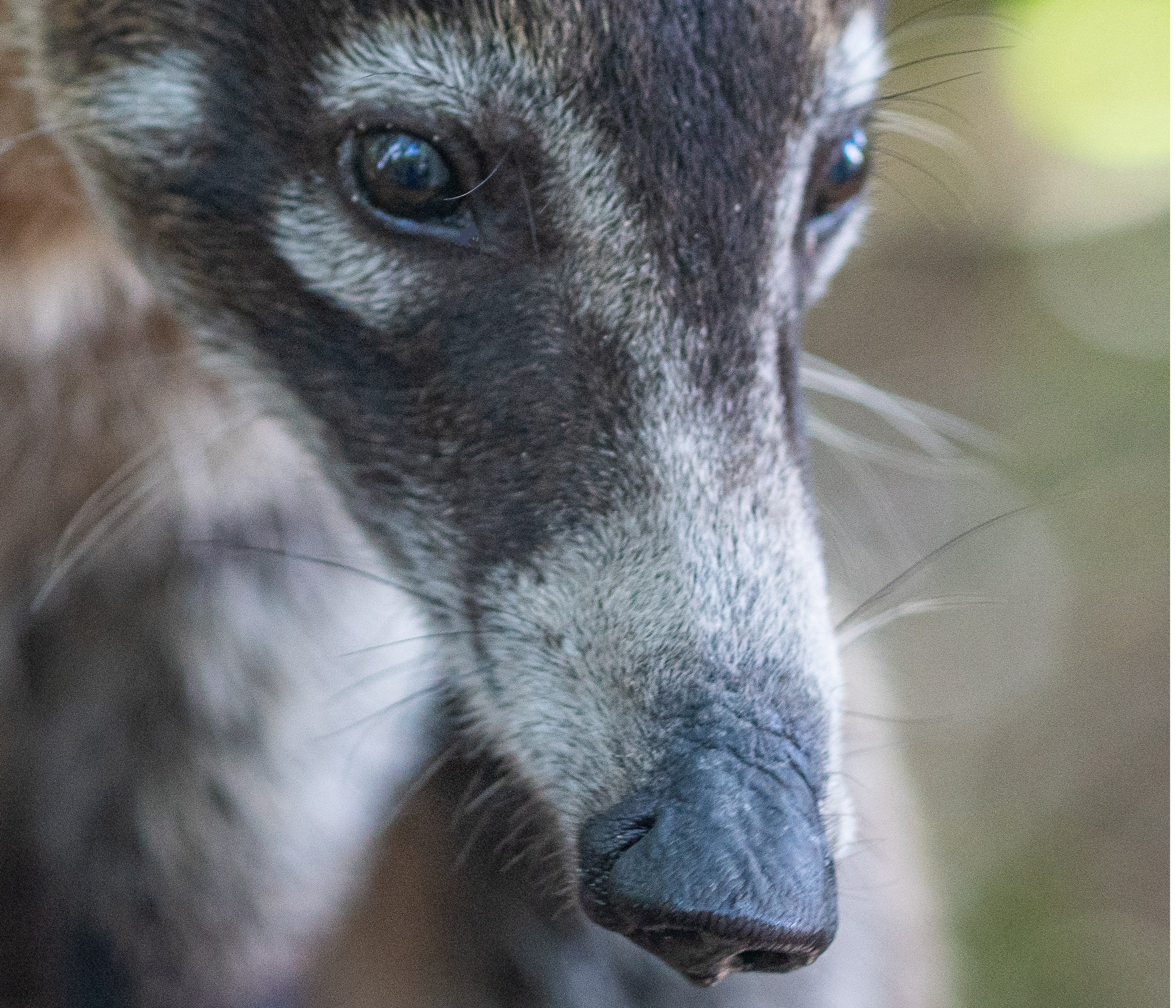
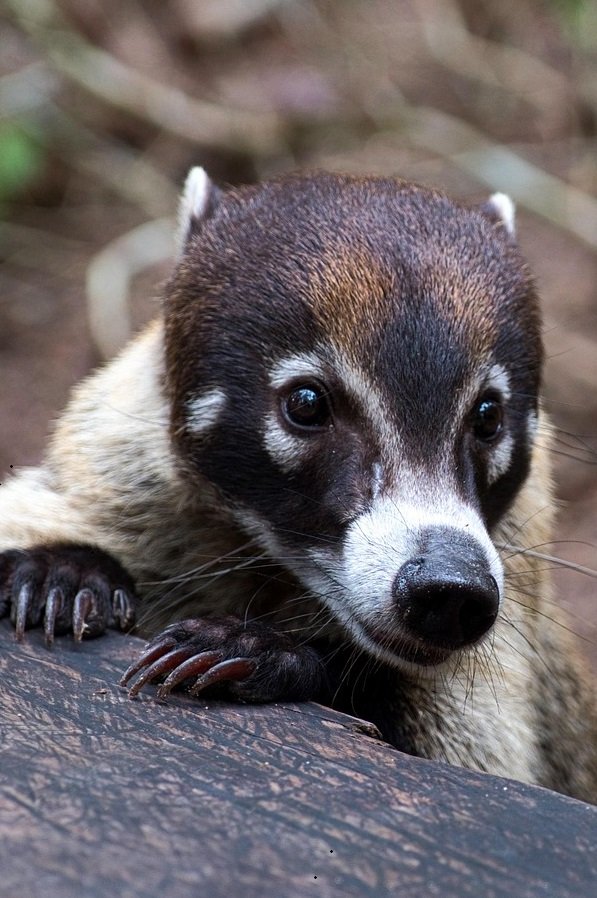 Portrait of a Mexican Raccoon
One of the coolest Mexican raccoon facts is that they are known as "snookum bears" among a host of other names, but the technical term for this adorable animal is coati, or coatimundi.
Mexican raccoons are highly intelligent animals about the size of a big house cat. They have typical raccoon mask-like coloration on the face, and rings around their tails, and are members of the raccoon family procyonidae, along with common raccoons, kinkajous and ring-tailed cats.
Coatis have a matriarchal social structure enforced by bond building activities like grooming, sharing in the rearing of young, and physical play. They live in very active groups of up to forty adult females and juveniles called bands.
They are very social, playful and affectionate with each other, and keep in contact through a variety of whistles, squeals, chatters and snorts while they move along foraging their territory. While their heads are down, busy noses to the ground, their tails are held straight up high like banners, making it easy to stay close to the group.
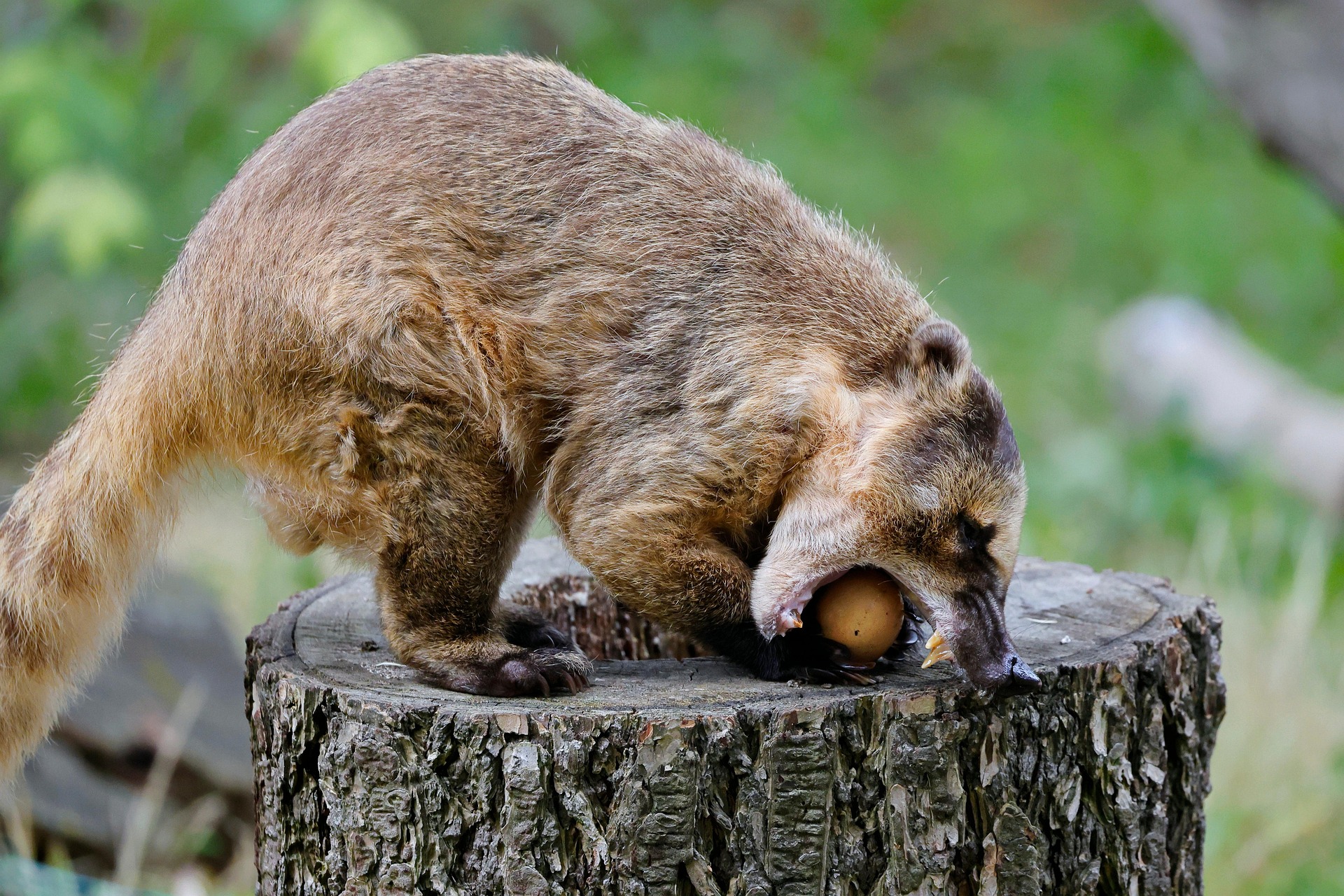
They use their powerful, long front claws and pig-like snouts to root out insects, reptiles and just about anything else edible that they can find on or in the ground.
Although they spend most of their time foraging in grasslands, or forest floors, they are semi-arboreal, nesting and sleeping in trees. Coatimundis are excellent climbers, but their expressive, powerful tail is not prehensile and cannot grip branches or objects.
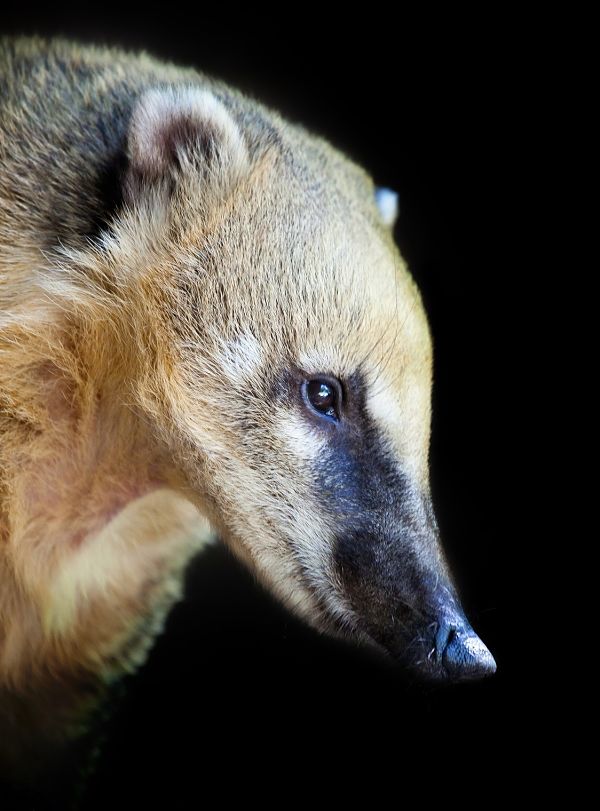
All the coatis have remarkably long snouts the tips of which are very flexible, constantly moving, and can actually bend from side to side at nearly 90 degrees.
There are four species of coati, the South American or brown-nosed, found in both Central and South America, the eastern mountain, found in Venezuela, the western mountain, found in Ecuador and Columbia, and finally the white-nosed coati.
The white-nosed coati is the species most often referred to as a Mexican racoon, because it ranges across all of Mexico, Central America and the South Western United States, including southern Texas, Arizona, and New Mexico.
All the species are foragers who will eat virtually anything from fruits and vegetables to fish, rodents and small birds.
Insects are a staple, since they hunt mostly on the ground, rutting with their nose, and will consume slugs, beetles, worms and crickets too. Invertebrates such as tarantulas and scorpions are on the menu also, and coatis seem to be immune to their bites and stings.
Mexican raccoon lifestyle
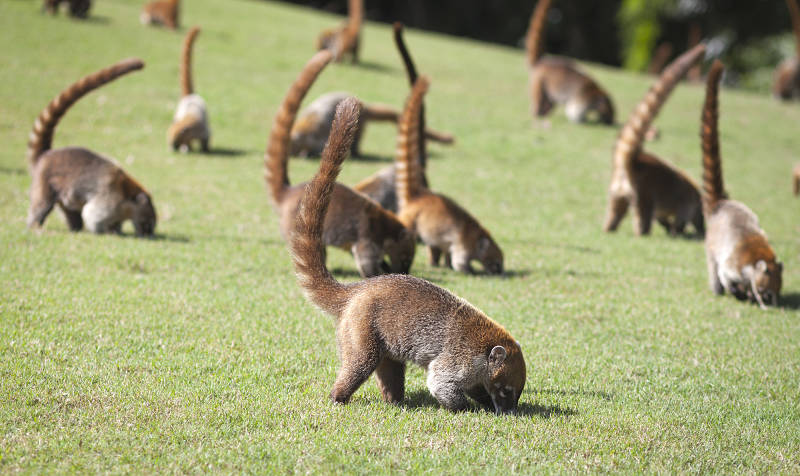 Band of white-nosed coatimundis
Two major differences between Mexican raccoons and common raccoons are that Mexican raccoons are very social creatures living in large matriarchal groups of up to 40 members, and are also diurnal, meaning they are active during the day. The common raccoons live mostly solitary lives and are nocturnal, meaning they are active at night, and notoriously so.
Coatis have a very unique completely matriarchal social structure. Their tight social groups, called 'bands', are made up of adult females and their young. Males are pushed out of the band at sexual maturity usually 2 or 3 years of age, and will only join a group again for a few days during mating season, and then only with the approval of the band.
The coati band spends most of their time busily foraging, mainly for insects. Moving along with tails up, they can easily keep track of each other, and may even signal direction, intention or danger with their tails.
Individuals take turns scanning for predators like dogs, jaguars, bears and even condors. They excitedly warn of any danger with a very dog-like woofing sound which sends the band scattering and scurrying up trees.
Coatis thrive in an amazingly wide range of habitats and climates from tropical rainforests to dust dry scrublands, mountaintops, cloud forests and urban landscapes, particularly those in Mexico and Brazil that are bordered by forestland. City coatis are famously bold and take happy advantage of tourist handouts and sites where they may exploit human activity, like garbage dumps and parks.
The greatest role of coatimundis ecologically is probably as propagators of a host of fruit and tree species. By eating assortments of vegetation and dispersing seeds over their large territories, they contribute to forest regeneration and plant diversity. They also contribute to their environment by controlling the populations of insects and vermin.
After a busy day of foraging, playing and grooming, the band will take to the trees to roost for the evening. They may build simple nests and pile together for safety and warmth. All members of the band look after youngsters and benefit greatly from pooling their nurturing resources.

mexican raccoon reproduction
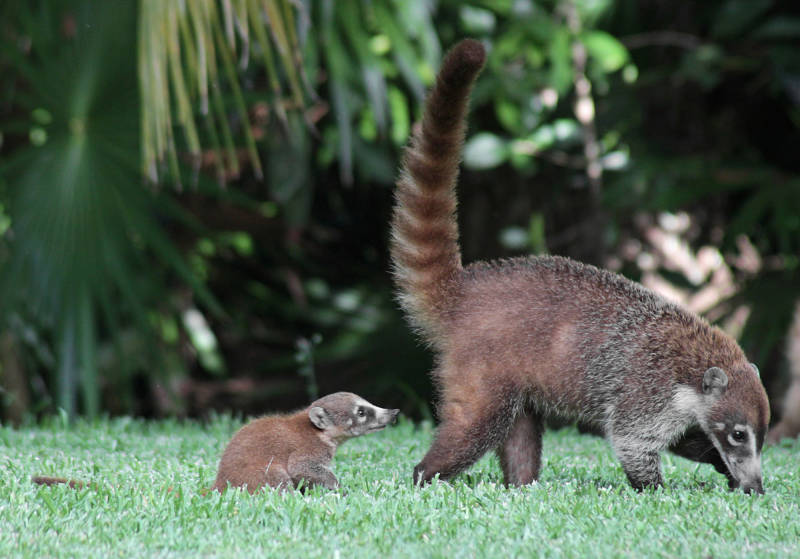
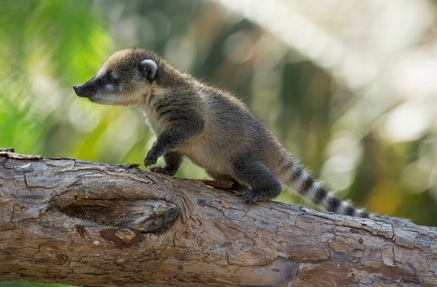 Baby coati, born in the trees
The breeding season for coatis is February and March. During this time, mature males who have been living alone attempt to join an accesable band (not the band they were born into) and gain favor with females by courting and grooming. Though they will dominate and chase male rivals, they remain submissive around desirable females who tend to prefer mild mannered partners.
Mating takes place in the treetops, and females, once impregnated, lose interest in adult males and chase them back to their solitary existence.
Pregnancy lasts about 11 weeks, and a few days before labor, expecting females go off on their own, build sturdy elaborate nests in the trees, and give birth to a litter of 2 to 5 babies called kits. Newborn coatis are blind, very finely furred, and just a few inches long. They spend the first few weeks of life in their treetop nest completely dependent on their mother.
These are perilous times for the little coatis who often fall prey to owls, raptors, snakes and other arboreal hunters. The mother must be wise and vigilant in order for her brood to survive, so she only leaves the nest occasionally to hastily forage up a meal of fruit or tarantula.
When the kits are strong enough to travel long distances, usually around 5 weeks old, the mothers return to the band where they will work together to raise them. All females participate in the protection, care and rearing of the young. Females will groom, clean and even nurse each others offspring in a true collaboration of collective support and maternal care.
Life within this band structure of mature females and juveniles provides protection, safety and learning experiences no single mother could provide on her own.
By 3 months old, baby coatis are actively foraging for their own meals. They are playful and affectionate with all members of the band and learn climbing skills and social boundaries by frisky interaction with the older juveniles who can teach them the ropes.
At 4 months youngsters are fully weaned and no longer dependent on their mother. Young coatimundis are fully grown at 14 to 18 months. Females reach sexual maturity at about 2 years old. Young males take a bit longer, but between 2 and 3 years old they are slowly pushed out of the band.
Most young males will move out before their third birthday. Some need more convincing, but eventually, if they don't take the hint, they will be aggressively chased from the group by the adult females, including their mother and sisters, before they reach their fourth birthday.
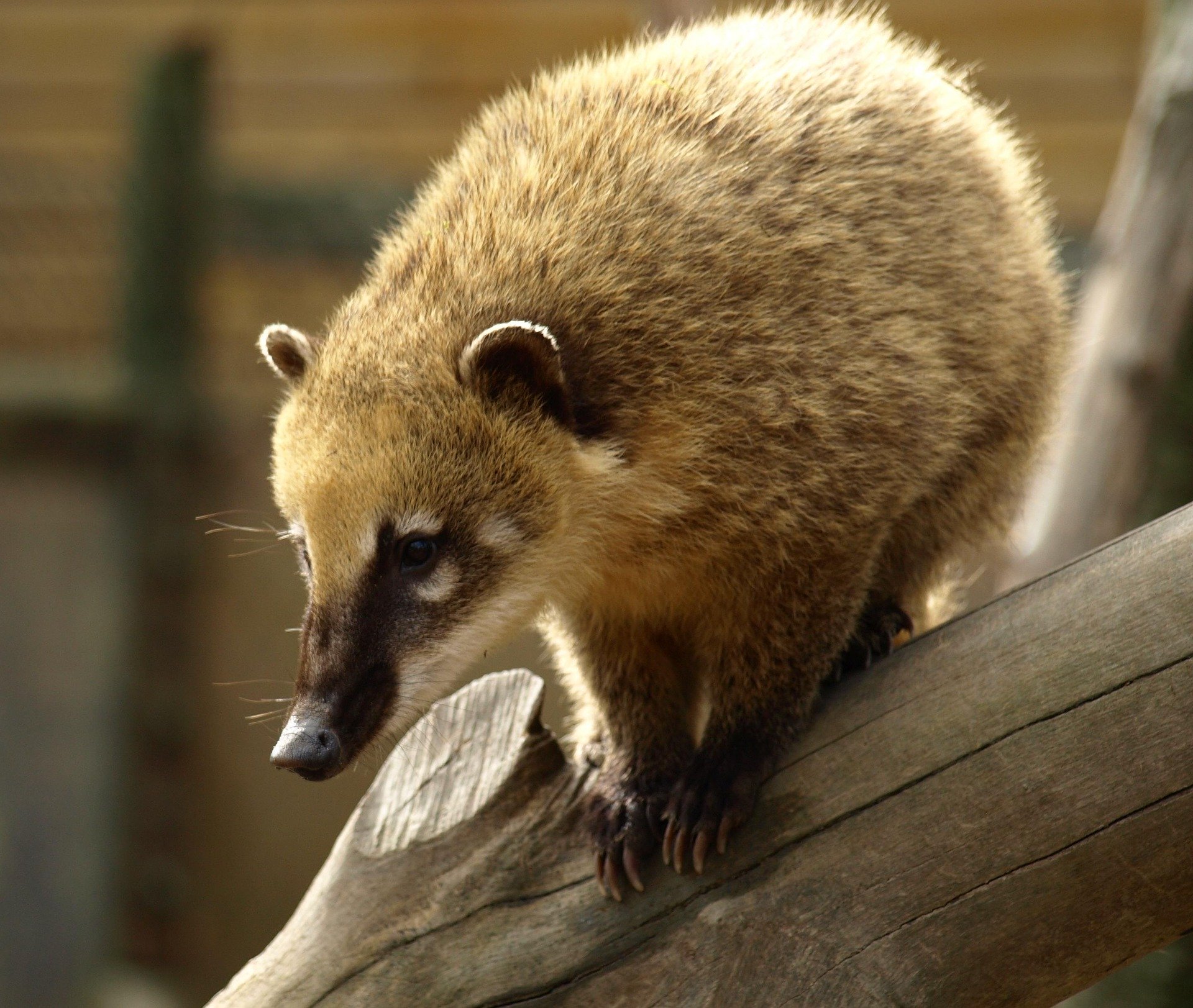 The Astonishing Shnozz
Coatimundi species
 coati with tails up!
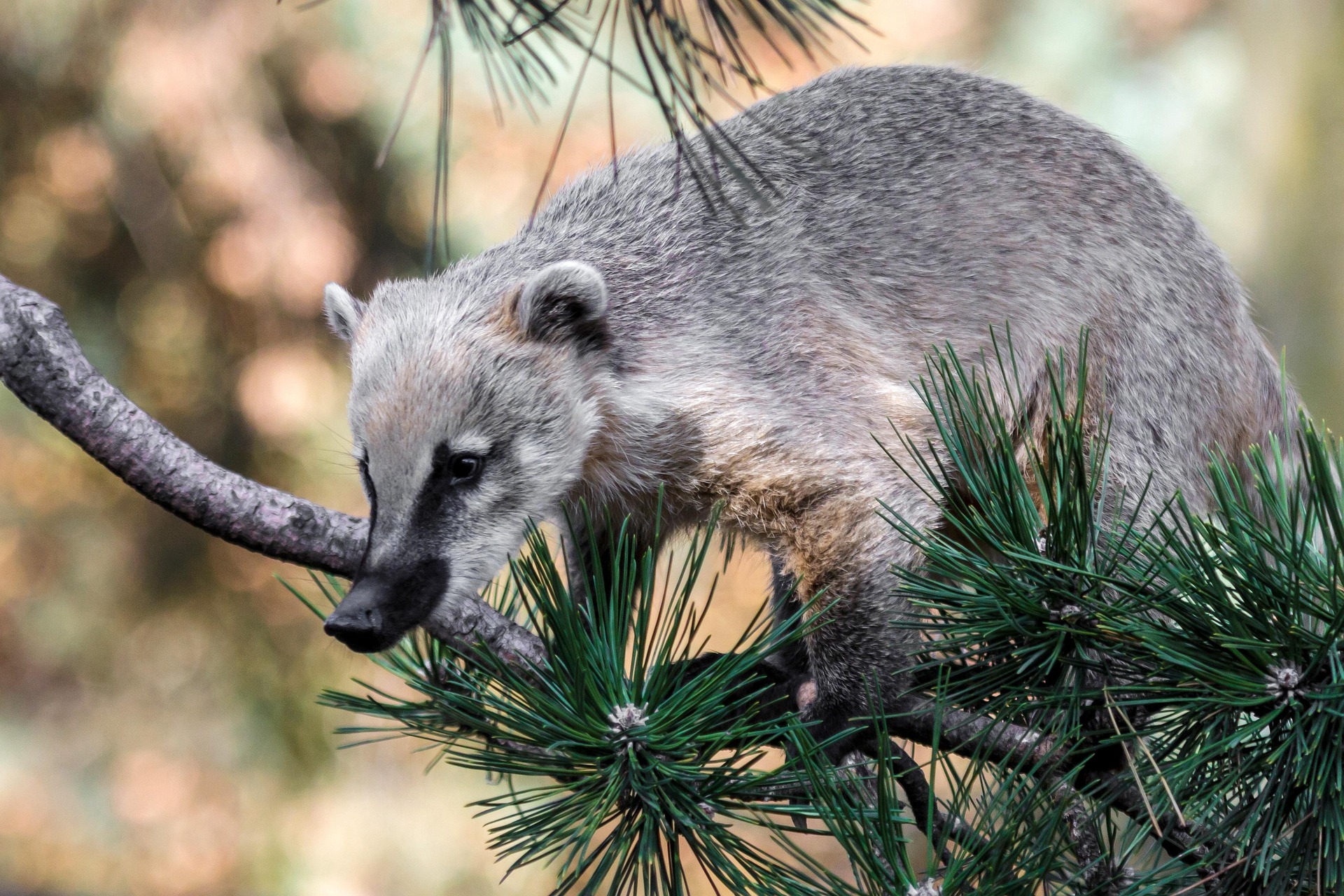 coati in pines
There are four known species of coati, the white-nosed coati, or Mexican raccoon, the brown-nosed or South American coati, the eastern mountain coati and the western mountain coati.
The Mexican raccoon, or white-nosed coati, is found in forest, farm, and scrubland throughout Mexico and Central America. It is about 12 to 15 inches at the shoulder, often chocolate brown in color, and weighs between 5 and 20 pounds. The area immediately around the nose and muzzle is light tan to nearly white, with the fleshy part of the nose being black or brown. The mask is tan or white around the eyes and often very dramatic.
The South American or brown-nosed coati is very slightly smaller and usually more reddish in color. It has a large range throughout much of South America. The snout is darker in color, and they have well defined rings on their tails. They are very common throughout their territory, and are also sometimes referred to as Mexican racoons, South American racoons, or southern racoons.
Both the mountain species of coati are smaller still, and are sometimes called 'dwarf coati'. They are more like squirrels in size, ranging from 3 to 10 pounds, and have less well-defined masks and rings. The western mountain coatimundi is found in Ecuador and Columbia, and is more overall brown in color, while the eastern, found in Venezuela, is more grey. Both of the mountain species are endangered due to loss of forest habitat in the mountain ranges of northern South America.
The white-nosed and brown-nosed coatis are not endangered and are common and relatively plentiful throughout there range, but deforestation could pose a threat eventually because all the coati species require forest and trees in which to breed, nest, and safely rear young.
Coatimundi matriarchy
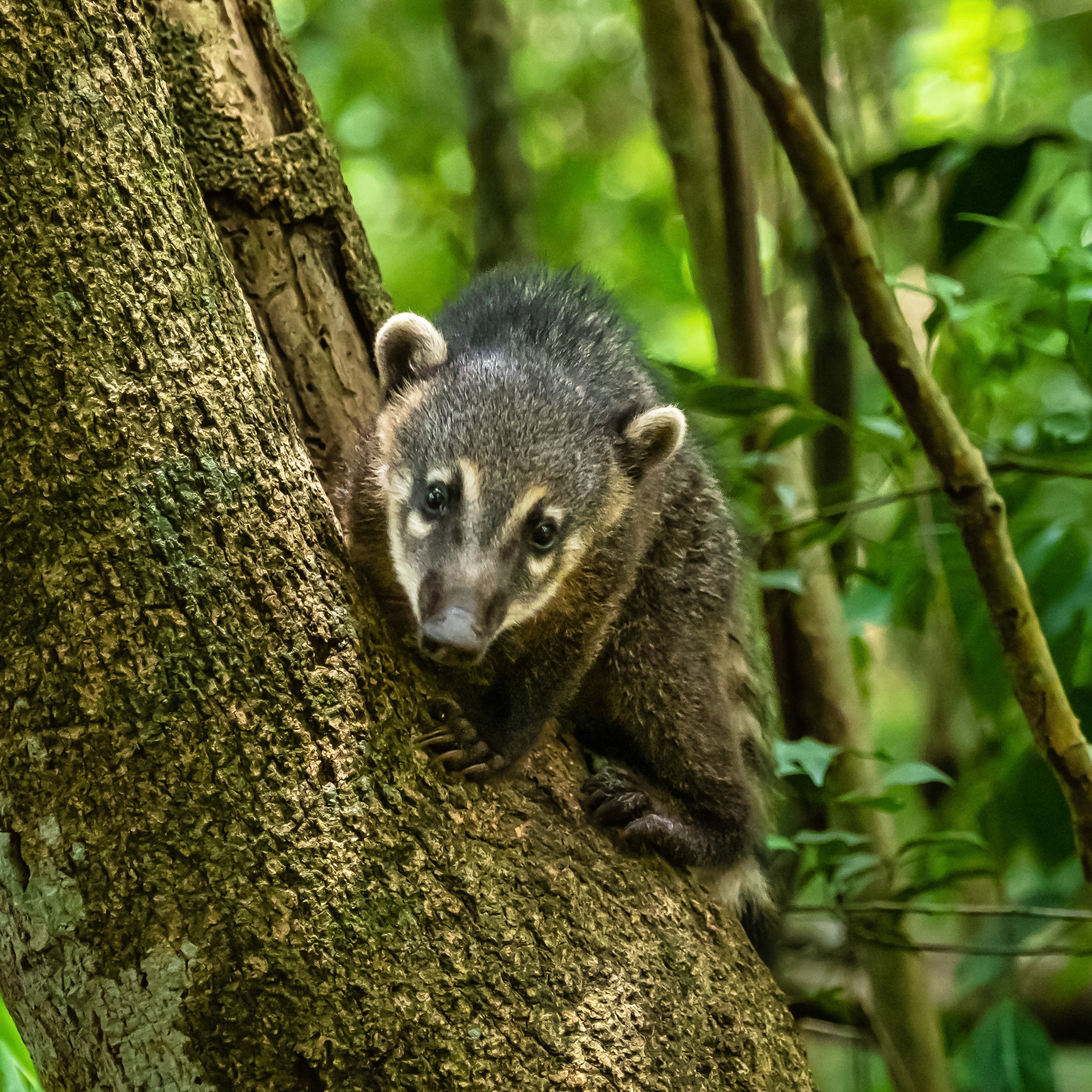
The two most abundant and successful species of coati, the brown-nosed or South American coati and the white-nosed or Mexican raccoon, both share the same unique lifestyle. Both of these species thrive in one of the more fascinating female led societies in the animal kingdom -true matriarchies.
In the coatimundi matriarchy, a tightly bonded band of 10 to up to 30 females -sisters, mothers and daughters, nieces, aunts and grandmas- are the architects and backbone of daily life. Adult males are not part of these groups. Juvenile males stay with their birth clan only until they reach sexual maturity. Then, at 2 to 3 years of age, they leave or are driven out to live a solitary life.
Young males move off to new locations and establish their own territories through scent marking, and squabbles with other lone males. They forage, hunt, and sleep completely on their own for the rest of their lives, except for a few days or weeks a year when mating season arrives each February and March.
Triggered by the signs of females coming into season they will approach bands in their area and work to ingratiate themselves with interested females through submissive grooming. Males rarely, if ever, return to their original band, and have nothing whatsoever to do with the rearing of young.
The coati matriarchy does not have a central leader or 'queen', if you will. Leadership and decision making is somewhat fluid, with older individuals often guiding band movements and choosing foraging spots, while younger members help with baby sitting, standing watch and sounding alarms.
While there are certainly some dominant individuals who clearly run things and are shown respect through grooming behaviors and details like first choice of prime resting spots, it is cooperation, not strict hierarchy, that keeps everything running smoothly.
In the coati matriarchy their domain is mastered by relationships not rivalries, proving that great strength and success can be achieved through the bonds of sisterhood.
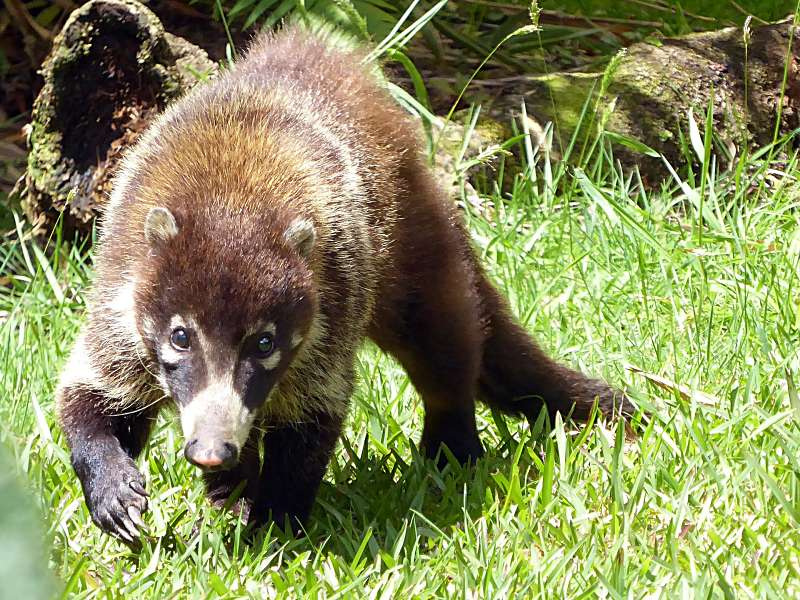 Solitary Male
Coatimundis and humans
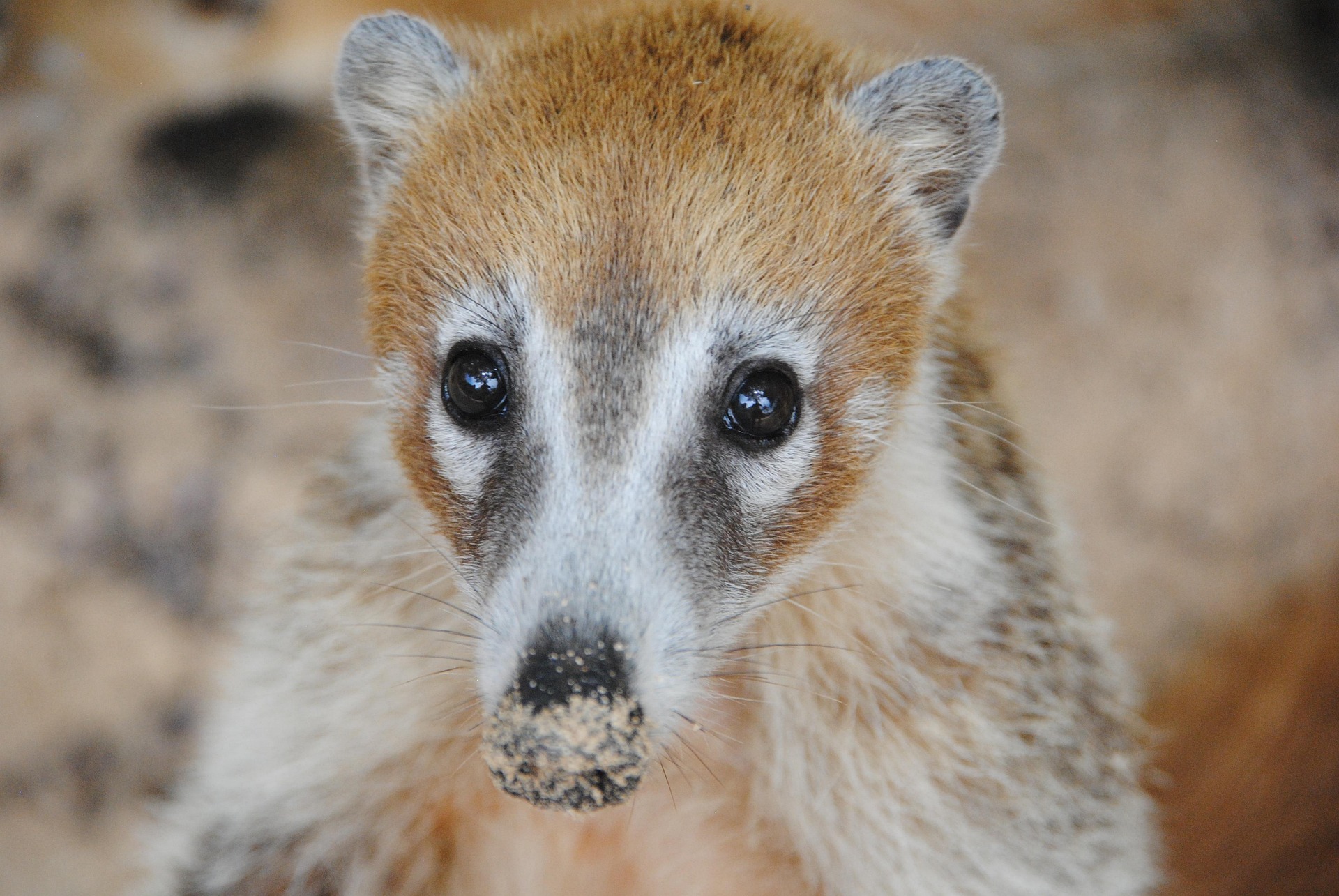 coati with a sandy nose
Most coatis live in close proximity to humans and as their territory and the forest land they require is encroached upon, that relationship can strain. The beautiful, entertaining animals that were seen while on a hike or nature trail are becoming increasingly viewed as pests when they appear at city dumps or busy tourist spots, but these animals are highly adaptable and it remains to be seen how or if they can blend with their quickly changing world.
In addition, because of increased exposure, people are more tempted to keep the Mexican raccoon as a pet. While bottle fed babies can be affectionate and playful, this is a highly driven and curious animal, similar to a monkey in intellect and social intensity, and requires enormous amounts of stimulation for its busy mind and body that the average household simply can't provide.
And don't forget these non-stop animals have a powerful urge to dig, since that's how they acquire their food in the wild, and they may cause quite a bit of damage in the typical home, pulling up floor tiles and carpeting and rooting through garbage and gardens. Definitely not recommended as a pet!
10 facts about mexican raccoon
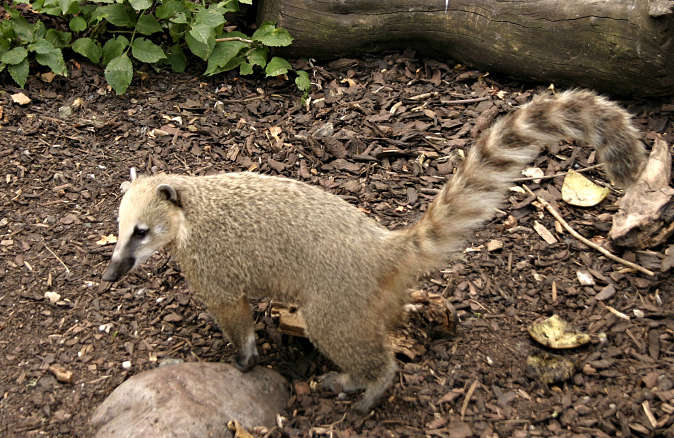
- The Mexican raccoon is formally known as the coatimundi
- Coatis have a matriarchal social structure
- Coatis have double-jointed ankles for climbing down trees head first
- There are four species of coati
- Their tails are longer than their whole bodies
- The Mexican raccoon is the species known as the white-nosed coati
- There are also common raccoons living in Mexico
- Coatimundi, quati, tejon and hog-nosed coon are some other names
- Tarantulas are a common part of the diet of a coati
- Coatis are members of the raccoon, or procyonid family
So Much More to Explore...

















see more animal extreme closeups
e-mail us at info@animalfactsencyclopedia.com




Copyright 2011 - 2026 by Jenise Alongi Animal Facts Encyclopedia.com